
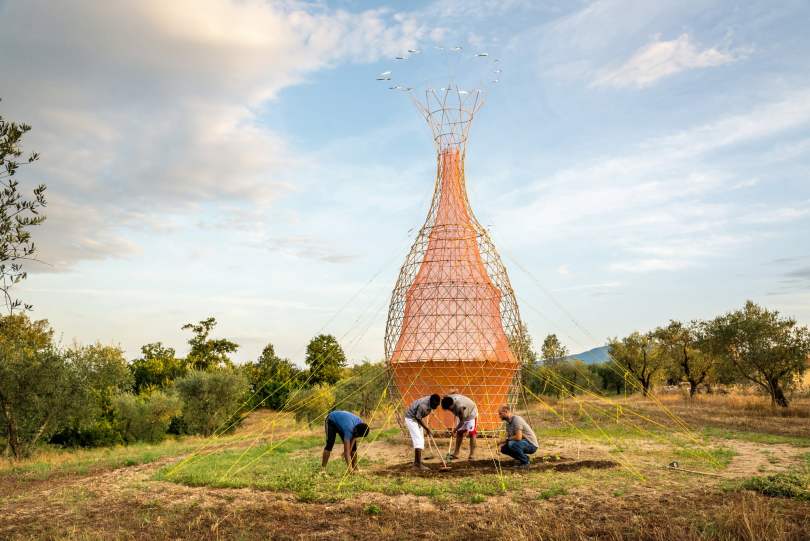
In many rural and arid parts of the world, access to clean drinking water is a daily struggle. For countless families, it means walking miles under a harsh sun, queuing up at unreliable water points, or depending on unsafe sources. It is in this everyday hardship that the Warka Water Tower finds its quiet purpose – and profound relevance.
Inspired by nature and tradition, the Warka Water Tower offers an elegant solution to a complex problem. Created by architect Arturo Vittori, the tower is named after the Warka tree of Ethiopia – a revered fig tree that serves as a natural gathering spot for communities. Much like its namesake, the Warka Tower is more than just a structure – it is a place of sustenance, dignity, and connection.
Standing nearly 10 meters tall, the tower is constructed from natural and locally available materials such as bamboo, jute rope, and mesh. At its core lies a simple yet powerful principle: condensation. As humid air passes through the mesh, it cools, condenses, and forms droplets. These droplets trickle down into a basin at the base – providing as much as 100 litres of drinking water per day under ideal conditions. No electricity, no moving parts. Just thoughtful design rooted in natural processes.
But what elevates the Warka Water Tower from a clever invention to a meaningful innovation is its human-centred design. It’s not parachuted in as a finished product – it’s built by the community. Its parts are low-cost, biodegradable, and easy to assemble. Its maintenance is minimal. In that simplicity lies its strength.
There’s something poetic about it too. Its silhouette – graceful and organic – blends with the landscape. It’s not an intrusion but an inclusion. People don’t just collect water here; they gather, converse, and reclaim their time and well-being.
For me, the Warka Water Tower is a textbook case of a Small Idea with a Big Impact. It doesn’t rely on high technology or vast capital. Instead, it draws upon context, compassion, and creativity. In doing so, it shows us a better way – where innovation respects local wisdom, enhances lives, and leaves a light footprint.
As climate change makes water scarcity more widespread and urgent, we’ll need more such low-tech, high-impact solutions. The kind that quietly transforms. The kind that belongs.
 Prabodh Jain